Defying Gravity and Groundwater: The Art of the Inventory-Driven Cofferdam
Project: Culvert Cofferdam | Location: Napoleon, Ohio
When you drive past a highway construction zone, you probably see a blur of dirt, steel, and yellow paint. But beneath the tracks of the excavators, a high-stakes battle is taking place. It’s a constant negotiation between physics, economics, and risk.
At Structured Design and Consulting, we don’t just observe that battle. We design the conditions so our clients win it.
The Mission: Replace the Culvert, Hold Back the Earth
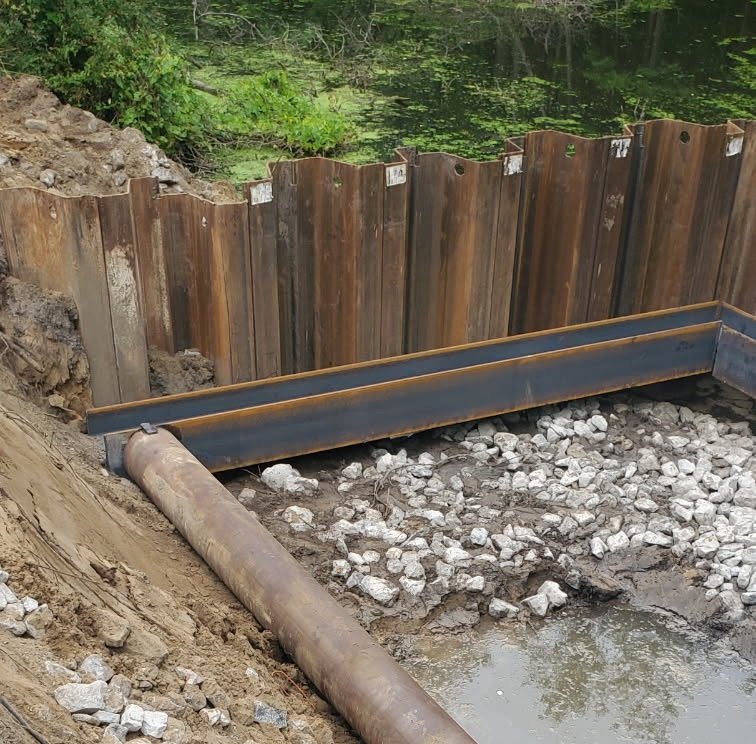
We recently partnered with a heavy civil contractor on an ODOT project in Lucas County. The objective was straightforward: replace a deteriorating stone tunnel with a modern Type B conduit pipe.
The challenge, however, was anything but simple. The contractor had to excavate an undercut 16 feet straight down through loose sand to get down to solid, stiff clay for structural bearing, all while groundwater worked relentlessly to turn the structural excavation into a pond. Keeping that excavation open and the crew safe required more than standard construction engineering; it required Inventory-Driven Design.
1. Don’t Buy New Steel, Use Your Yard
Most academic engineering starts with a blank slate and a steel catalog, selecting the lightest and newest sections that satisfy a theoretical model. We take a different approach.
For this project, the contractor already owned PZ-27 sheet piles and HP14x89 Waler beams. Instead of pushing new procurement, our role was to verify whether their existing inventory had the reserve capacity to safely do the job.
This approach saves money, eliminates lead-time delays, and reduces the environmental impact of rolling new steel that doesn’t need to exist. We turned “steel sitting in the yard” into a precision-engineered safety system.
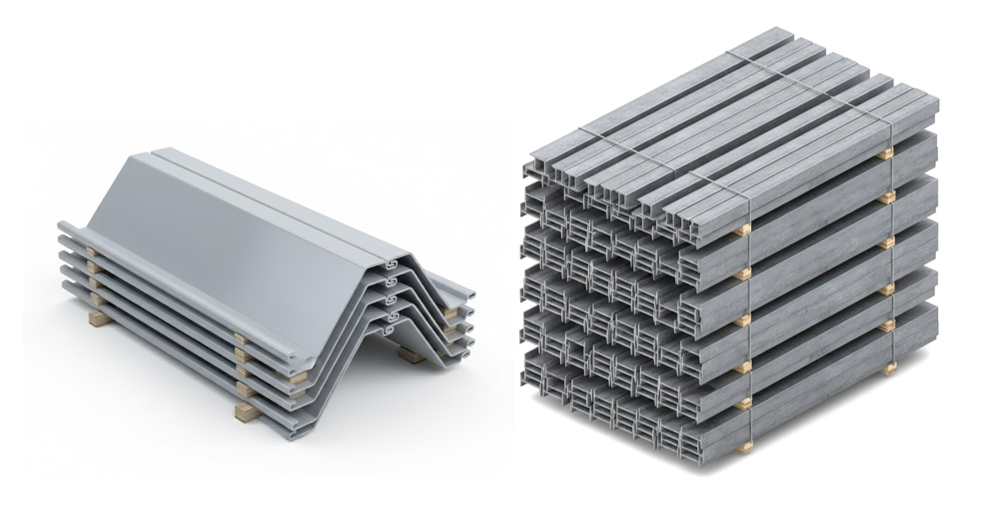
The Result: Instead of buying new steel, we verified the ‘Reserve Capacity’ of the existing assets.
2. The Invisible ‘Bathtub’ Effect
A 16-foot-deep cofferdam does more than hold back soil; it creates an empty bathtub in the ground, and nature hates empty spaces.
At that depth, groundwater alone exerts roughly 1,000 pounds per square foot of pressure against the walls. Ignore that force, and the system doesn't just leak—it fails.
The project geotechnical data showed a clear soil stratigraphy: loose sand ($\phi=29^\circ$) overlying stiff clay. Those two layers behave very differently under load. If you do not respect that transition, the walls do not just move; they buckle. Our analysis ensured the excavation functioned as a controlled structure, not a trap.
Technical Snapshot:
- Hydrostatic Pressure: ~1,000 psf at the base.
- Soil Stratigraphy: Layer 1: Loose Sand | Layer 2: Stiff Clay.
- The Result: A design that balances soil friction and clay cohesion simultaneously.
3. The “Cliff Edge” of Risk
Engineering behavior is non-linear. We compared a 16-foot excavation to a 19-foot excavation using the same system. The results were not incremental—they were jarring.
At 16 feet, the system was rock solid. At 19 feet, internal forces spiked so aggressively that the cofferdam was barely holding on. Rather than giving the contractor a vague “yes,” we gave them a hard boundary. By identifying that "cliff edge," the field crew could work confidently within safe limits and know exactly when to stop before conditions became dangerous.
4. Practicality over “Fancy”
The contractor proposed using field-available steel brackets instead of ordering specialized hardware. In many corporate engineering environments, that idea is dismissed outright.
We ran the numbers. The field solution provided a cleaner load path and greater reserve capacity than the catalog option. It was simpler, stronger, and immediately available. Efficiency is not about being fancy; it’s about being right.
The Bottom Line
Civil engineering is not just about calculations; it’s about collaboration. When a contractor’s boots-on-the-ground experience is combined with rigorous structural verification, routine work becomes a masterclass in efficiency.
We do not just design structures. We provide value AND protect people.
Does your engineer work for you, or for the steel catalog? If you are ready to leverage your existing inventory and tackle deep excavations with confidence, let’s talk.
Playing The Game
In the real world, success requires a strategic mindset and the ability to manage pressure. Try the mini-game below and see how quickly the ground pushes back.
Think you have it? Try the mini-game below and see how quickly the ground pushes back.
Controls: Click “+” to dig and, Click “-” to fill.